

In southwestern Madagascar, the coastal communities of the rural municipalities of Betsinjaka and Saint-Augustin are taking decisive action to restore and protect their mangrove ecosystems while creating sustainable livelihood opportunities for vulnerable households. Through the MIATRIKA Project, funded by the Critical Ecosystem Partnership Fund (CEPF), communities are leading efforts to strengthen environmental resilience and improve economic wellbeing in the Atsimo Andrefana region.
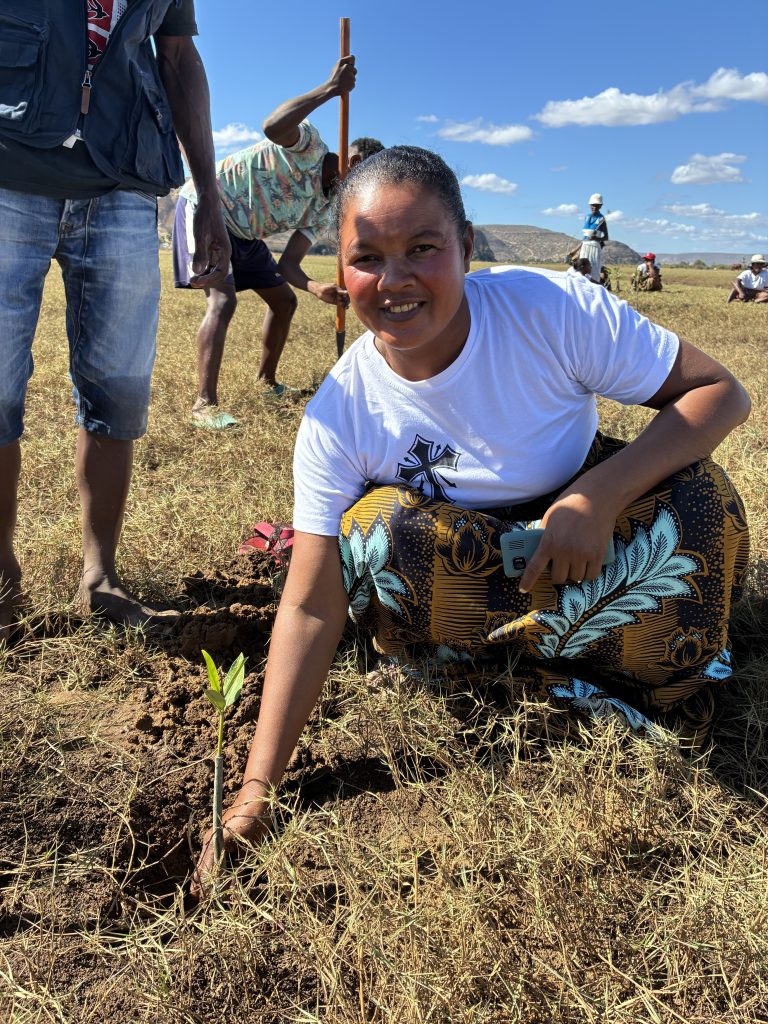
In Ankilibe, Sarodrano, Mitsinjo-Lavenombato, and Lovokampy Sud, four community nurseries have been established, run by sixteen nursery workers recruited and trained within the villages themselves. Under their responsibility, 84,193 mangrove propagules notably Avicennia marina, Rhizophora mucronata, and Ceriops tagal have already been potted before being replanted across a total area of 30 hectares along the coastline.
Around these nurseries, a network of more than 500 active reforesters has formed, recruited from the four intervention villages. Their engagement reflects a tangible commitment on the part of residents to the health of their coastline, an ecosystem on which fishing, erosion protection, and, more broadly, family livelihoods depend.
While mangrove restoration remains central to the project, MIATRIKA also recognizes that long-term conservation depends on sustainable livelihood opportunities for local families. This is precisely the focus of MIATRIKA’s “livelihoods” component, which is already supporting 30 families in agroforestry, 20 in beekeeping, and 30 in rice-fish farming. The careful selection of beneficiaries including door-to-door verification of each household made it possible to form solid groups, ready to receive technical training and initial equipment (hives, fingerlings, seeds).
At the same time, 15 village savings and loan associations (VSLAs) have already been set up, supervised by five community agents trained in the fundamentals of VSLA operation and management, as well as in financial education. These groups provide families with a concrete savings and mutual-support tool, rooted in local practices, and are expected to expand as new villages join the initiative.
The success of MIATRIKA project cannot be measured solely in hectares planted or beneficiaries supported: it also depends on the strong community ownership, with local nursery workers, reforesters, community leaders, and TAMIA members playing a central role in planning and implementation and these structures will sustain these gains over time. To that end, fifty members of the TAMIA association and community leaders have been trained in sustainable natural resource management and conflict resolution, following a process of analysis and dialogue with existing governance bodies.
The coming months will be marked by the continuation of mangrove planting, the launch of technical training in beekeeping, agroforestry, and rice-fish farming, the training of twenty community patrollers in the LEM/SMART monitoring software, and the establishment of a community-based monitoring system in each intervention fokontany, in collaboration with the 20 community members forming an operational committee. In 2027, training for thirty young people in ecotourism is also planned, opening up new economic prospects linked to coastal conservation.
As MIATRIKA continues through 2028, communities in the Atsimo Andrefana region are not only restoring critical coastal ecosystems but also building the skills, institutions, and livelihood opportunities needed to ensure that these gains are sustained for future generations.